According to IMF sources the organization intends to boost its lending capacity by 600 billion dollars in order to be better prepared to shield the global economy from the EU debt crisis. Eurozone nations will provide 150 billion dollars, while other EU member states might contribute 50 billion. Other G20 countries still remain undecided on whether to participate. This issue will be discussed at the upcoming G20 summit which will take place in Mexico on 25-26 February.
Already yesterday IMF head Christine Lagarde signalized a need for joining efforts in order to boost lending resources: “The biggest challenge is to respond to the crisis in an adequate manner and many executive directors stressed the necessity and urgency of collective efforts to contain the debt crisis in the euro area and protect economies around the world.”
Kathleen Brooks, Research Director UK EMEA at FOREX.com, thinks that convincing other countries to contribute might be a difficult task: “The knee jerk reaction to the IMF news is to be expected, however, could the markets be over-reacting? There is no commitment of more monies for the IMF, and the US and UK have already come out and said they won’t pay in any extra to the fund to prop up the Eurozone, so Lagarde has a tough round of negotiations to try and reach her $1 trillion target, especially since the current IMF war chest is only $385bn.”
Greece PSI deal still doubtful
On one hand, we had a Greek finance ministry official quoted by varies sources trying to reassure the market about Greece getting close to reach an agreement with private creditors by the end of the week, saying they could have a deal with the IIF very soon. The Financial Times also reported that Greece was nearing a deal with private-sector creditors on debt swap talks.
On the other hand, a total different story can be learnt if one is to check today's greek bond market performance, with yields still on the rise, suggestive that the market is not expecting a PSI (private sector involvement) deal.
The Financial Times, in a rather contradictory way, released another report later on the day, suggesting the deal is nowhere in sight: "Several hedge fund managers that hold Greek debt have said they have not been involved in the talks and will not be agreeing with the “private sector involvement” (PSI) deal – which centres on a 50 per cent loss on bondholders’ capital and a reduction in the interest they receive."
The report added: "Even members of the committee concede the process is unlikely to succeed in time for the crunch date: a €14.5bn bond repayment falling due on March 20."
Portuguese and German yields decrease at debt sale
Portuguese borrowing costs fell at the short-term debt auction held on Wednesday. The country managed to sell 2.5 billion euros worth of bonds out of the 3 billion euro target. The yield on April 2012 T-bills remained unchanged at 4.346%, the yield on July 2012 notes fell to 4.74% (vs 5.25%) while December 2012 papers yielded 4.986%.
Meanwhile Germany, which also auctioned debt today, sold 3.44 billion euros of 2-year bonds out of a target of 4 billion euros at an average yield of 0.17% (in comparison with 0.29% the country had to pay last month).
Fitch: Italy's rating might be cut by two notches
After declaring on Tuesday that Greece is inevitably heading towards a default, Fitch rating agency announced today that a two-notch downgrade of Italy is possible in the nearest future.
Alessandro Settepani, senior director for business and relationship management at Fitch in Italy said that: “A downgrade by two notches is one of the possible options. The committee will assess the rating of Italy on the basis of refinancing levels and measures for growth.”
Thursday, January 19, 2012


Sunday, January 15, 2012
Super Charging Affirmations
Affirmations are one way to install an empowering belief and to weaken (or eliminate) a limiting belief. An affirmation is best stated when it's simple, brief, positive, and in the present tense.
Another way to make it more credible is by turning it into a question. Our minds assume the truth of the question and go on a search for the answers. In what ways does the market provide me with abundant opportunity? By turning the affirmation into a question, you avoid the oh yeah? response.
Once you have your affirmation worded effectively, you can super charge it by making a mental image of the affirmation fulfilled. You can construct a still picture or create a mental movie, a vivid daydream of the affirmation happening. Either way, take time to make the picture clear, vivid, focused, up front and near enough to feel present. Once you have the picture step out of the picture so you see yourself in the picture.
A picture, it has been said, is worth a thousand words. When you say your affirmation in the future, that picture will flash into your mind. For example, when you say, The market is my partner in success, a picture of yourself trading profitable in synch with the market will reinforce the affirmation.
Once you have the affirmation and the image, you want to super charge it with feelings. Thought mixed with feeling acts like a magnet to bring that thought into reality.
For example, when you say, I consistently follow my trading guidelines, and in the back of your mind you see a picture of yourself doing that, you allow yourself to feel the confidence and trust in your methods and the probabilities that enable you to be consistent with your rules and strategies.
Now you have an affirmation that is so powerful, it will manifest itself in your trading. You have combined your desire with your imagination. Your will power is now supported by your imagination. You affirm yourself to trading success.
Of course, you still have to find out what works, verify that it works, and apply it to your trading. Simple wishing is not enough to win.
- I am a disciplined trader.
- The market provides me with an abundance of opportunity.
- The market is my partner in success.
- I consistently follow my trading guidelines.
- I am a winner. I think like a winner. I do the things that winners do.
Another way to make it more credible is by turning it into a question. Our minds assume the truth of the question and go on a search for the answers. In what ways does the market provide me with abundant opportunity? By turning the affirmation into a question, you avoid the oh yeah? response.
Once you have your affirmation worded effectively, you can super charge it by making a mental image of the affirmation fulfilled. You can construct a still picture or create a mental movie, a vivid daydream of the affirmation happening. Either way, take time to make the picture clear, vivid, focused, up front and near enough to feel present. Once you have the picture step out of the picture so you see yourself in the picture.
A picture, it has been said, is worth a thousand words. When you say your affirmation in the future, that picture will flash into your mind. For example, when you say, The market is my partner in success, a picture of yourself trading profitable in synch with the market will reinforce the affirmation.
Once you have the affirmation and the image, you want to super charge it with feelings. Thought mixed with feeling acts like a magnet to bring that thought into reality.
For example, when you say, I consistently follow my trading guidelines, and in the back of your mind you see a picture of yourself doing that, you allow yourself to feel the confidence and trust in your methods and the probabilities that enable you to be consistent with your rules and strategies.
Now you have an affirmation that is so powerful, it will manifest itself in your trading. You have combined your desire with your imagination. Your will power is now supported by your imagination. You affirm yourself to trading success.
Of course, you still have to find out what works, verify that it works, and apply it to your trading. Simple wishing is not enough to win.
Wednesday, January 11, 2012
Trading Psychology: Three Losses in a Row
3 losses in a row are tough. That’s about the most consecutive losses that novice traders are psychologically prepared to accept before they feel compelled to take action and ‘correct’ the situation.
If you’re anything but a total newbie, I’m sure you’ll recognize the symptoms:
Frustration – Why me? I’ve worked so hard. Everyone else in the forum appears to be getting good results with this strategy? Nothing ever works out for me.
Frustration – Why me? I’ve worked so hard. Everyone else in the forum appears to be getting good results with this strategy? Nothing ever works out for me.
Anger - That strategy developer is a liar and a crook. My broker is running my stops. Someone should be held accountable for this.
Doubt – What if the strategy doesn’t work? What if I can’t trade? How am I going to support my family?
Fear– I can’t lose more money, what will everyone say about me when they know I’m a loser? How can I tell my wife/husband that I’ve lost again?
And if that’s not enough, the novice trader will likely be afflicted with the crippling inability to pull the trigger on the next trade, in fear of hitting a fourth loss in a row.
Doubt – What if the strategy doesn’t work? What if I can’t trade? How am I going to support my family?
Fear– I can’t lose more money, what will everyone say about me when they know I’m a loser? How can I tell my wife/husband that I’ve lost again?
And if that’s not enough, the novice trader will likely be afflicted with the crippling inability to pull the trigger on the next trade, in fear of hitting a fourth loss in a row.
Usually, there is one of two responses:
1) The strategy is tweaked to ensure that the modified version would not have triggered these losing trades, through:
a) Swapping one indicator for another,
b) Optimising indicator parameters, or
c) Adding an additional filter.
2) Totally abandoning the strategy, usually followed by returning to their favourite forum to find the next Holy Grail strategy that is designed to make their dreams come true.
1) The strategy is tweaked to ensure that the modified version would not have triggered these losing trades, through:
a) Swapping one indicator for another,
b) Optimising indicator parameters, or
c) Adding an additional filter.
2) Totally abandoning the strategy, usually followed by returning to their favourite forum to find the next Holy Grail strategy that is designed to make their dreams come true.
Is this the right response though?
Typically, trading decisions which are influenced by emotions rarely result in the right action.
Typically, trading decisions which are influenced by emotions rarely result in the right action.
So, what should be done?
First, before we continue, you need to confirm that you do have a valid, proven trading strategy. Have you conducted appropriate testing to satisfy yourself that it provides a positive expectancy? If not, stop trading it right now and return to testing. I don’t care what reason you had for jumping straight into a live trading environment, but the fact is that it’s difficult to psychologically trade a strategy in a consistent and disciplined manner when you don’t have complete confidence in its rules. You need to conduct thorough testing.
First, before we continue, you need to confirm that you do have a valid, proven trading strategy. Have you conducted appropriate testing to satisfy yourself that it provides a positive expectancy? If not, stop trading it right now and return to testing. I don’t care what reason you had for jumping straight into a live trading environment, but the fact is that it’s difficult to psychologically trade a strategy in a consistent and disciplined manner when you don’t have complete confidence in its rules. You need to conduct thorough testing.
But assuming you have a strategy that has proven itself through positive results either in a testing or live tradingenvironment, simply refer to your testing results or pasttrading history, and you’ll confirm that three losses in a row is a quite normal occurrence. In fact, it’s quite normal to have a lot more than three in a row. And it does not mean that your strategy is flawed.
Let’s look at this from a purely statistical perspective.
Let’s look at this from a purely statistical perspective.
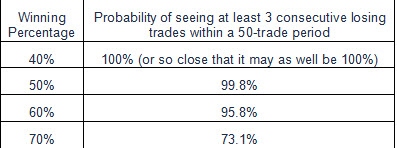
The table above shows that given a trading strategy with a 50% win/loss ratio, the probability that you’ll get a string of three losses in a row somewhere within your next 50 trades is 99.8%.
Even if you’re achieving a win/loss ratio of 70%, you’ve still got a 73.1% chance of having a string of three losses somewhere within your next 50 trades.
It’s going to happen. It’s a normal occurrence. Accept it.
So, based on this, what’s a reasonable response from a trader following three losses in a row?
So, based on this, what’s a reasonable response from a trader following three losses in a row?
The first thing is to confirm all three trades were entered and managed in accordance with your plan. You should be doing this for every trade anyway, but if you’re a very short term trader then perhaps you don’t get an opportunity till after the session is over. If that’s the case, and you’ve get three consecutive losses which appear to be worrying you, pause to review them now. If they’re not valid trades, find out why you entered them, refocus on your plan and your goals and then continue trading. However, if they’re valid trades, you might want to consider the following action:
1) If you’re a mechanical trader, keep trading.
2) If you’re a discretionary trader, check to see if each entry is actually at the same setup area. If so, you’re possibly just not reading the market right at the moment. Consider halting your trading until the market action has changed and a new setup has developed.
3) If you still find yourself experiencing difficulty in pulling the trigger, get away from the markets for a while.
a) It’s time to take a break – relax, refresh and recharge yourself.
b) Review your trading plan and your historical results (either live or testing).
c) Carry out some visualisation and affirmation sessions, to prepare yourself for pulling that trigger once your break is over.
d) Return to the markets with the goal of correct application of your plan – don’t focus on the dollars won or lost, instead focus on the process of trading.
4) And if on returning you still find problems, well you’ve got some more serious issues that need to be worked through. I don’t mean that in a bad way, but you need to take a longer break to seriously review both your trading plan and yourself:
a) Are you taking too much risk per position? Reducing your position size can often make an incredible difference in your ability to trade in a relaxed and confident manner.
b) Do you really understand and accept the probabilistic nature of the markets? I’d suspect not. Read “Trading in the Zone” by Mark Douglas for a brilliant insight into these issues.
c) Are you consumed by fear of loss whenever it comes time to enter a trade? What is it you fear exactly? Maybe it’s time to delve into the world of trading psychology. “The Psychology of Trading” and “Enhancing Trader Performance” by Dr Brett Steenbarger would be my recommended starting point.
2) If you’re a discretionary trader, check to see if each entry is actually at the same setup area. If so, you’re possibly just not reading the market right at the moment. Consider halting your trading until the market action has changed and a new setup has developed.
3) If you still find yourself experiencing difficulty in pulling the trigger, get away from the markets for a while.
a) It’s time to take a break – relax, refresh and recharge yourself.
b) Review your trading plan and your historical results (either live or testing).
c) Carry out some visualisation and affirmation sessions, to prepare yourself for pulling that trigger once your break is over.
d) Return to the markets with the goal of correct application of your plan – don’t focus on the dollars won or lost, instead focus on the process of trading.
4) And if on returning you still find problems, well you’ve got some more serious issues that need to be worked through. I don’t mean that in a bad way, but you need to take a longer break to seriously review both your trading plan and yourself:
a) Are you taking too much risk per position? Reducing your position size can often make an incredible difference in your ability to trade in a relaxed and confident manner.
b) Do you really understand and accept the probabilistic nature of the markets? I’d suspect not. Read “Trading in the Zone” by Mark Douglas for a brilliant insight into these issues.
c) Are you consumed by fear of loss whenever it comes time to enter a trade? What is it you fear exactly? Maybe it’s time to delve into the world of trading psychology. “The Psychology of Trading” and “Enhancing Trader Performance” by Dr Brett Steenbarger would be my recommended starting point.
One final thing! If three losses in a row does not necessarily equate to a flawed strategy, then at what point should you stop trading and review your plan? Well, I don’t base this on a particular number of losses in a row, but rather on a level of drawdown. Only you can determine what should be considered a normal level of drawdown, based on your historical performance. But certainly, if you equal the historical maximum drawdown for your strategy (if not sooner) then you should be reviewing your strategy to confirm it’s based on sound fundamental principles that still apply to the current market environment. And at some stage of drawdown beyond this point, you need to have clearly defined STOP criteria. Don’t bleed your account to death. Stop, take a break if necessary, reassess the situation, conduct further testing and return stronger than ever before.
Subscribe to:
Posts (Atom)